
Liposuction Tools: Cannulas and Other Types of Plastic Surgery Equipment
All surgical procedures have their standard tools, equipment, and protocol. Liposuction is a surgery that depends on suction assistance. The general tools of liposuction include cannulae (or cannulas, both are versions of the plural are widely used) to filtrate solutions into the tissues, to break up and/or tunnel through the fat, and to suction it out.
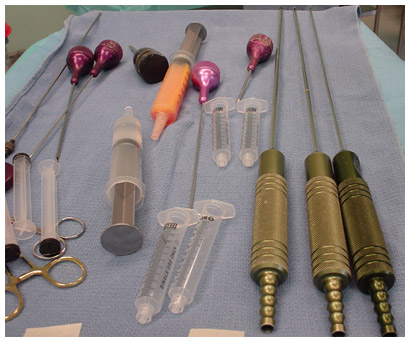
Cannulae
Cannulae, also called suction wands, are the plastic surgery tools surgeons use to tunnel in and around the area of fat to be removed and to break up or melt (though internal ultrasound-assisted liposuction), and suction the liquefied fat by using a vacuum pump. These actions are simultaneous.
The cannula is probably the most visible and widely known instrument in a liposuction. They are hollow metal tubes, usually made out of titanium or stainless steel, and are anywhere from 26 to 36 cm long and from 1.4 to 5 mm in width, but some are larger. There are also microcannulae that are used in spot-liposuction, or microliposuction. Different length cannulae are used for different target areas. Some cannulae have several ports or holes at the far end, several millimeters back from the tip, and some just have only one port at the tip. Some cannulae emit ultrasonic energy that melts fat and which are used in ultrasound-assisted liposuction (UAL). We will discuss UAL in the Techniques section. There are several types of cannula tips available, from sharp to beveled to bullet-shaped ones, and even odd shaped, roughly surfaced tips. There are also reciprocating cannulae used in power-assisted liposuction (PAL).
The Infusion System
A tumescing solution, which includes local anesthetic (lidocaine), a vasoconstrictor (epinephrine), and saline (sterile salt water), is introduced into the tissues with an infusion or infiltration system. This is done using a blunt-tipped cannula with many ports at the free end or a large blunt syringe that looks a bit like a turkey baster. These are variations on these instruments depending on the preference of your surgeon. The amount of fluid infused depends on the technique preferred by the surgeon as well. Whatever the amount, the solution is either manually injected or pumped in.
The Aspiration System or Device
The electric vacuum pump, called an aspirator or aspiration platform, and collection reservoir system are the main attraction in liposuction. These machines are hooked up to tubing that is attached to the cannula. The machines have adjustable levels of negative pressure (suction) from very low for UAL or other types which fat is melted beforehand to high suction used in dry techniques. There is actually more bleeding in dry techniques and also tissue damage is more likely with intense suction.
Not all plastic surgeons will use motorized aspirators but most do. The cannula can be attached to a syringe to manually suction out the fat. Manual syringe-extracted fat procedures take longer, but are thought by many surgeons to cause less tissue damage to the patient. They are also thought to damage the fat cells less, if the removed fat cells will be used for reimplantation in a fat grafting procedure. In general, syringe aspiration is time consuming and not as efficient as using an aspirator.
Aspiration Tubing Suspension Systems
Not all surgeons use tubing suspension systems in their operating rooms, and they are often not seen in hospital operating rooms. Surgeons who have their own surgical centers and perform many liposuction procedures may have these. Tubing suspension systems help keep the tubing tangle free and organized. Suspension systems also increase the ease with which the surgeon can manipulate the cannula and hoses.
These systems are very state-of-the-art and are a plus for the surgeon in ease of performing your procedure. Some surgeons believe a tubing suspension system to be merely a luxury. On the other hand, many surgeons report after having worked with a suspension system, they'll never go back.
Additional Liposuction Tools
If internal UAL is used, small plastic inserts will be placed into the incisions to guard the incision edges from being burned. This is an important piece of equipment for this procedure. In external UAL, a gel will be placed on the skin to help with the movement of the ultrasonic paddles and to help conduct the sound waves.
Patient Suspension Systems
Frequently, a patient undergoing liposuction needs to be turned, moved, or even placed upright during the procedure. Patient suspension systems help in lifting a patient to a standing position or other position to inspect progress intraoperatively and to help with fat removal. Many surgeons believe treating a patient in an upright position towards the end of the procedure can improve results because fat and skin can be observed as it naturally hangs.
A suspension system is not a necessity as many times the patient is awoken and, with the help of the surgical staff, can stand on his or her own. Not all surgeons finish liposuction with the patient upright. Many surgeons are able to get great liposuction results without these systems.